





Digital Supply Chain Programme: Made Smarter Innovation | Digital Supply Chain Hub
Creating a virtual hub, data observatory and network of industrial living labs to optimise information flows across manufacturing supply chains.

BusbySim is a model-based safety engineering platform which drafts safety and certification evidence directly from a live model enabling this work to stay in sync with the design.
Its platform was made viable by the introduction of an open standard, SysML v2, which serves as a highly capable and interoperable modelling language. Until quite recently, a workable solution for maintaining a formal engineering model in a textual format that large language models could dependably interpret and modify simply did not exist.
Working with Digital Catapult and the UK Digital Twin Centre, BusbySim partnered with Flyer AI to develop a live model of Flyer AI’s aircraft functions, architecture and failure behaviour, enabling safety and certification evidence required by regulators to be drafted much more quickly. Founded by former RAF test pilot Justin Paines, Flyer AI builds autonomous delivery aircraft.
The success of this project has resulted in Flyer AI moving from being a grant-funded consortium partner to a valued customer of the BusbySim platform. The tool developed during this collaboration is regularly used by its engineering team and the partnership continues beyond the programme.
BusbySim had a working prototype capable of drafting initial safety artefacts, but no evidence that it could perform on a real aircraft, within a real programme and to a standard that regulators would accept. The company had never run the approach against a live certification submission. It needed a proof of concept and evidence that a regulator would accept safety evidence drafted from a live design model, validated by engineers.
At the same time, Flyer AI was dealing with the time-consuming Specific Operations Risk Assessment (SORA) submission process, which is how the Civil Aviation Authority (CAA) approves drone operations in the UK.
Before an aircraft is permitted to fly, its manufacturer must prove to the regulator that it is safe. Risk has to be classified on the ground and in the air. It’s demanding for a small team and uses valuable time and resources to map flight geography, ground and air risk mitigations, operational safety objectives, and carry out a full safety analysis.
Engineers were doing this work by hand, across documents, spreadsheets and disconnected specialist tools. The process was slow and error-prone, and every time the design changed, the analysis had to be reconciled and reworked. A full safety case could take a department of engineers the better part of a year, and often a consultancy budget on top.
Another issue is that the industry is short of qualified safety engineers. This is a serious problem when drone companies, autonomous aircraft and a wave of novel crewed designs have all moved from research projects into funded programmes with real timelines, and every one of them needs safety evidence.
With the support of Digital Catapult and the UK Digital Twin Centre, BusbySim could change Flyer AI’s problematic safety evidence workflow completely.
Its tool holds the aircraft’s functions, architecture, requirements and failure relationships in a single live model. The safety documents are drafted from that model rather than assembled separately alongside it, so when the design moves, the safety analysis moves with it. A qualified engineer reviews, edits and approves every output and remains responsible for the safety case.
Flyer AI could see in real time how a change to its operating operations affected the assurance level and evidence burden. Safety stopped being a downstream deliverable and became something it could steer while the design was still moving. This saves time and money.
For this project, BusbySim had to build:
Flyer AI’s SORA submission, drafted in BusbySim and approved by engineers, was accepted by the Civil Aviation Authority, enabling Flyer AI’s uncrewed aircraft to fly in April 2026 to complete the world’s first drone delivery of fish and chips to the broadcaster James May.
The Digital Twin Adoption Accelerator programme from Digital Catapult and the UK Digital Twin Centre gave BusbySim six months’ funding to develop the BusbyFlyer software. Partnering with Flyer AI provided access to a real aircraft, regulator and a deadline which put the tool in front of a working engineering team on a live certification submission.
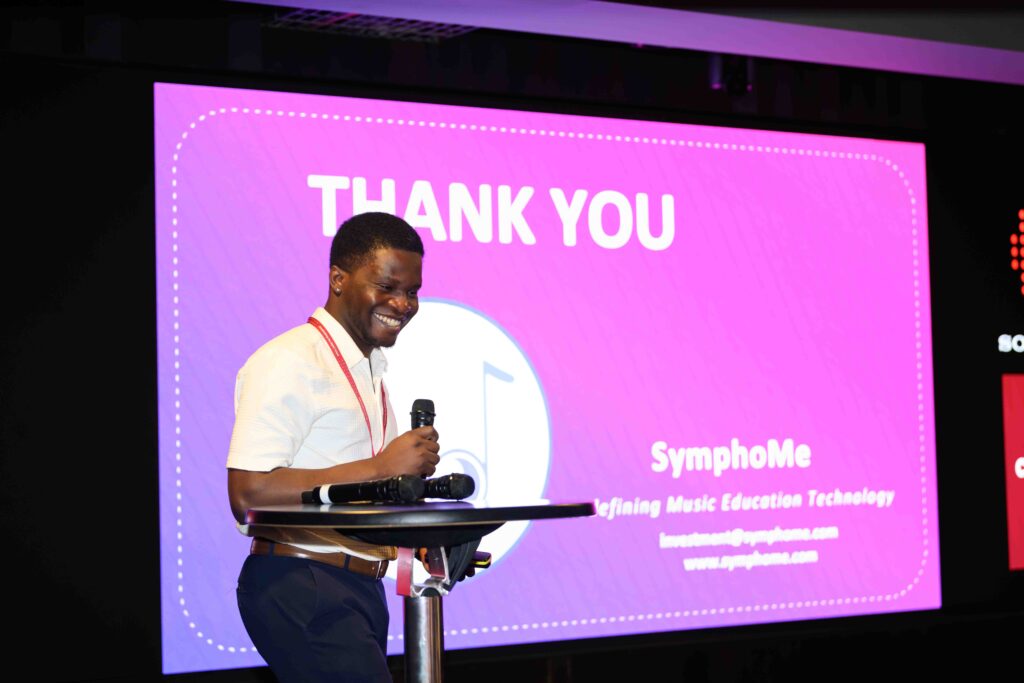
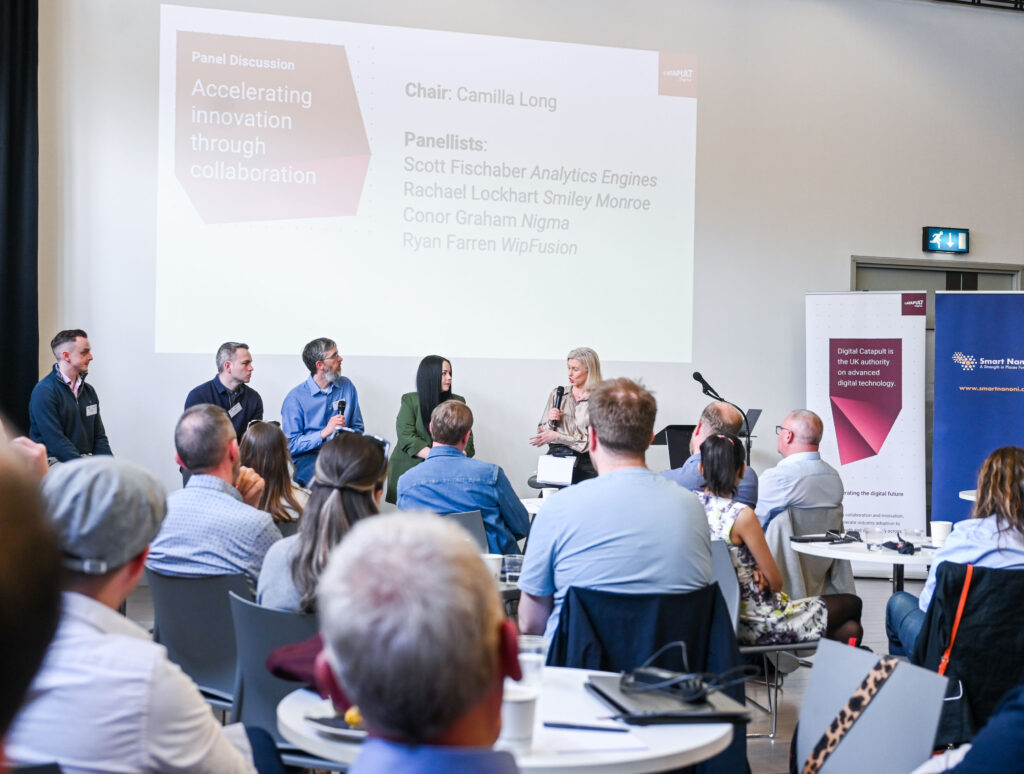
Commercial support changed how BusbySim positioned the product and a showcase event in Belfast created connections the company is still working through.
The inbound enquiries BusbySim now receives, the pilot programmes it is scoping, and the investment it has raised since can all be traced back to its ability to demonstrate its capabilities through the case study with Flyer AI and the UK Digital Twin Centre.
The UK Digital Twin Centre Accelerator programme enabled BusbySim to move a credible idea into a proven solution.
“Working with Flyer AI through the UK Digital Twin Centre programme gave both partners a growth journey neither of us could’ve had otherwise. Daily contact and close collaboration with Flyer’s engineers enabled us to ship new features and have our ideal customer test them right out of the box, while they got tailored features built around their needs to help them hit their goals faster. A rare privilege for early-stage startups!” Asia Belfiore Founding Engineer, BusbySim
Safety evidence drafted in BusbySim was accepted by the Civil Aviation Authority as part of Flyer AI’s submission, on a live programme rather than a test case.
The time reductions on this work were substantial. The preliminary system safety assessment from blank sheet to draft was carried out in under two days – against Flyer AI’s own expectation of three months or more. The functional hazard assessment took one day, compared to an expectation of two months or more. Both outputs were reviewed and validated by Flyer AI’s engineers before submission.
Flyer AI has converted from a grant-funded partner to an early adopter of the platform and has chosen BusbySim as its ongoing partner for safety evidence on its next and considerably more demanding submission.
BusbySim achieved its Cyber Essentials certification and is continuing to have conversations with defence and industry, generated largely through the UK Digital Twin Centre’s showcase event that concluded the programme.
“BusbyFlyer showed what’s possible when the digital twin extends into assurance and certification, linking the live design model directly to the evidence needed for regulatory approval. Having that evidence accepted by the regulator on a flying aircraft is practical evidence that digital twins can transform how complex systems are designed, assured and certified. That’s exactly the kind of demonstrable impact the UK Digital Twin Centre and the Adoption Accelerator programme is here to deliver.” Dr Katrina Thompson, Director, UK Digital Twin Centre

The timing of this project is extremely favourable. The UK Defence Investment Plan announced in June 2026 commits over £5 billion across four years to drone and autonomous systems, and the stated intention is to field autonomous capability rapidly while reducing assurance friction.
Assurance friction is precisely BusbySim’s problem space, and it arrives at that conversation with a regulator having already accepted its outputs.
In the near term, BusbySim is targeting UK drone and small manned-aircraft companies with active certification programmes, a market of tens of thousands of systems and safety engineering seats, with a clear path into larger manufacturers, defence and international markets as the platform matures
Over the next three years, growth is likely to come from three directions: unmanned air-vehicle operators and manufacturers needing operational approvals, small and mid-sized manned aircraft manufacturers needing ARP4761-structured evidence, and pilot programmes inside larger aerospace manufacturers.
The immediate priority is proving the approach on a larger and more complex programme. BusbySim wants to hear from anyone working in a safety critical workflow (in aerospace, automotive or those working with complex systems) where it could help, particularly those operating at a higher required integrity level.
Meanwhile, the partnership with Flyer AI continues and the team is growing at BusbySim.
“BusbySim’s tooling makes one of the hardest tasks in design and development, systems engineering and systems safety management, an order of magnitude quicker and simpler. I would have given my right arm for this tool in some of my previous work.” Justin Paines, Founder and CEO, Flyer AI