






Digital Supply Chain Programme: Made Smarter Innovation | Digital Supply Chain Hub
Creating a virtual hub, data observatory and network of industrial living labs to optimise information flows across manufacturing supply chains.
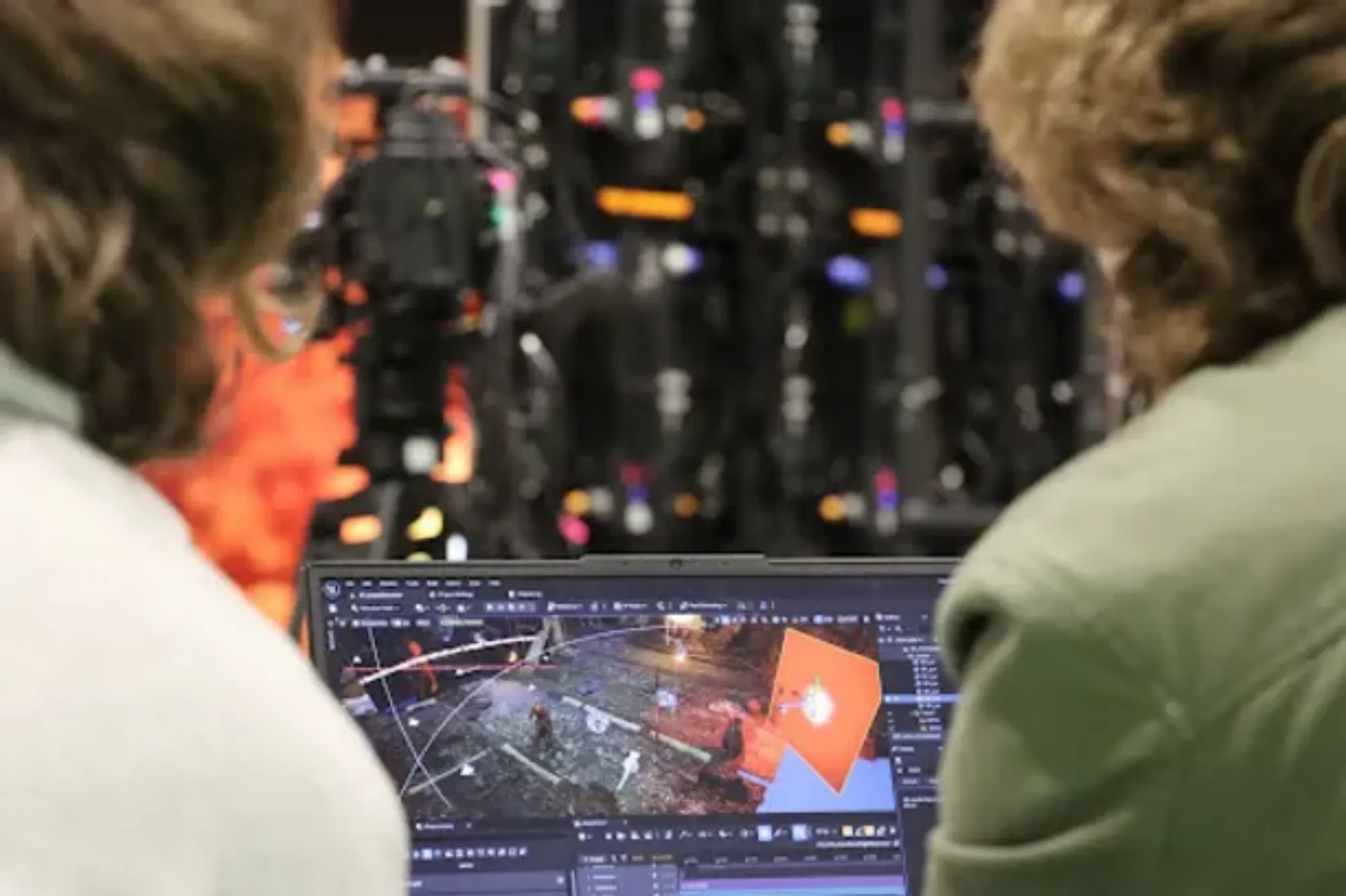
The D’Arcy Thompson Simulator Centre’s sustainaVERSE™ platform turns complex engineering and environmental data into clear, interactive 3D visualisations.
Based near St Andrews in Scotland, the company helps organisations managing critical infrastructure, natural resources and offshore operations plan effectively, assure safety and make evidence-based decisions where clarity and trust in data are essential. It sits between technical modellers who produce data and the people who must act on it including crane operators, bridge teams, regulators, insurers, investors and boards.
The D’Arcy Thompson Simulator Centre (DTSC) team wanted to turn a proven visualisation capability into a licensable product with recurring revenue. The offshore lifting market was chosen as the focus for the first of these products because the consequences of getting lifting operations wrong are severe and the current evidence process is slow and manual.
Its industry adopter partner, Deep Tek Ltd, designed a drum winch that uses a high modulus polyethylene (HMPE) rope in place of steel wire rope. HMPE is as strong as steel, but effectively weightless in water.
Working with Digital Catapult and the UK Digital Twin Centre, The DTSC and Deep Trek created sustainaVERSE™ SUBSEA, a task-level digital twin of a subsea deployment and recovery system that can plan lifts, monitor rope condition and generate certification evidence.
The DTSC had a working visualisation platform, but its task-level subsea twin was at proof-of-concept stage and had not been validated against real operational data.
Meanwhile, the barrier for Deep Tek lay in confidence, not capability. Adopting synthetic filament rope in place of steel allows a reduction in vessel size for the same task, as well as savings in capital costs, fuel and emissions. However, its HMPE rope was still regarded as a new material by a conservative industry, so owners, operators and their clients were reluctant to adopt it.
Certifying such a system under the classification society standard required evidence that the rope has sufficient remaining working life to complete the deployment and recovery operation safely.
Proving this meant bringing together vessel motion, crane and winch behaviour, environmental conditions and rope’s operational history in near real time. Before this project, no task-level digital twin combined these factors and turned the result into evidence a certifying body would accept. This gap was both the challenge and the commercial opportunity.
There was also a market pull. Regulators, insurers and financiers were asking for better evidence earlier, while the offshore wind and decommissioning markets were creating demand for exactly this kind of rope-based lifting assurance.
“We had a genuinely better way of lifting things from the seabed – synthetic filament rope instead of steel. It is just as strong but weightless in water and lets you do the same job from a smaller vessel. What we did not have was a way to prove it to the people who invest in, design, build, own, operate, certify, insure and finance these operations. The Digital Twin Adoption Accelerator came at exactly the right moment.” Charlie Bavington, Company Secretary, The D’Arcy Thompson Simulator Centre
Deep Tek’s crane system was being prepared for service on the offshore subsea construction vessel HEA Oceanic. This gave the DTSC the opportunity to work with a real vessel, in an operational setting, with real world data and a genuine certification process.
Advances in technology mean that real-time 3D engines, geospatial streaming and open model-exchange standards have reached the point where an immersive, accurate twin can run on ordinary hardware, including on a ship’s bridge, rather than requiring a dedicated simulator facility.
Development ran from December 2025 to June 2026. The DTSC led software development, integration and assurance outputs; Deep Tek led operational data access, trials and validation.
Two significant technical decisions were taken during delivery. Rather than building bespoke animations of one crane, the team developed a generic, data-driven method using Unreal Engine’s Control Rig. This allowed sensor data to drive the visualisation, which could be repurposed for other cranes and vessels. The team also built a plug-in architecture on a standard communication protocol, avoiding reliance on a single fixed data connection and allowing third-party data sources to be added quickly.
The solution was the development of sustainaVERSE™ SUBSEA, a task-level digital twin of a complete subsea deployment and recovery operation. It brings together the vessel, crane, drum winch, rope and the payload as a single system.
A physics and rope-behaviour model interpret the data to estimate how much of the rope’s safe working life has been consumed, and the result is shown as an interactive 3D scene located at the actual worksite. The crane and rope mirror the movement of the real equipment, while the rope’s condition is displayed through a simple colour-coded indicator along its length.
The benefits of this solution include:
For the vessel owner and operator: Fewer offshore trial days, faster assembly of certification evidence and the ability to rehearse a lift before it happens. Rope changeouts can also be planned, reducing costs and the risk of unplanned failure.
For the crane and bridge teams: The twin gives a shared, intuitive picture of what is happening, so the bridge team, crane operator and onshore supervisor can see the same thing at the same time.
For decision-making and governance: Technical and non-technical stakeholders, including insurers, financiers and clients, can look at the same evidence and reach the same understanding. This shortens the conversations that can delay adoption of something new.
For the wider industry: A repeatable, lower-cost route to the certified use of synthetic filament rope in offshore lifting.
For the DTSC: A productised, licensable module set rather than a bespoke project, and a demonstrated capability which can be taken into adjacent markets.
The DTSC’s original plan was a simplified visualisation using pre-built animations of the crane. This would be adequate for a demonstration but offered little scope for further use or development.
The Digital Twin Adoption Accelerator programme from Digital Catapult and the UK Digital Twin Centre provided the capacity to do the job properly rather than expediently. The funding and technical confidence offered by the programme allowed for a generic, data-driven approach in which real sensor data would drive the crane visualisation. The resulting capability is now a reusable asset for future vessels the company works with.
Digital Catapult and UK Digital Twin Centre technologists helped to select an appropriate authentication approach for connecting to a remote vessel system as this was an area outside of the DTSC’s core expertise. The masterclasses and mentoring on business models for delivering digital twins as a service also directly shaped how to package and price the product.
The consortium structure of pairing a technology vendor with an industry adopter was also formative. The DTSC worked directly with Deep Tek, the ship’s operator and crew, allowing the interface to be designed around standard operating procedures rather than what was convenient to implement.
The programme demonstrated that, in a regulated industry, trust in a digital twin comes from being able to show the accuracy and uncertainty of its outputs within defined error bounds, not simply from producing convincing results. That reshaped The DTSC’s roadmap.
The immediate outcomes and achievements include:
Showing a working twin running on real vessel data and producing evidence aligned to a classification society standard, changes the nature of a customer conversation.
“Enabling technical and non-technical people to look at the same data in the context of time, place, environmental forces and ambient conditions, all supported by ‘numbers’, establishes a precious ingredient to the technology mix, at a much earlier stage – trust.” Moya Crawford, Managing Director, Deep Tek Ltd
The DTSC’s immediate priority is to complete the transition from a validated prototype to a supported product.
In parallel, it is extending the work in three directions:
“Digital twins support our growth because they change what we sell. We move from selling expert time, which does not scale, to licensing a platform that makes expertise reusable. The company would welcome continued collaboration with Digital Catapult and the UK Digital Twin Centre as its scale-up proceeds, particularly around validation and access to adjacent sectors.” Charlie Bavington, Company Secretary, The D’Arcy Thomson Simulator Centre