







Digital Supply Chain Programme: Made Smarter Innovation | Digital Supply Chain Hub
Creating a virtual hub, data observatory and network of industrial living labs to optimise information flows across manufacturing supply chains.
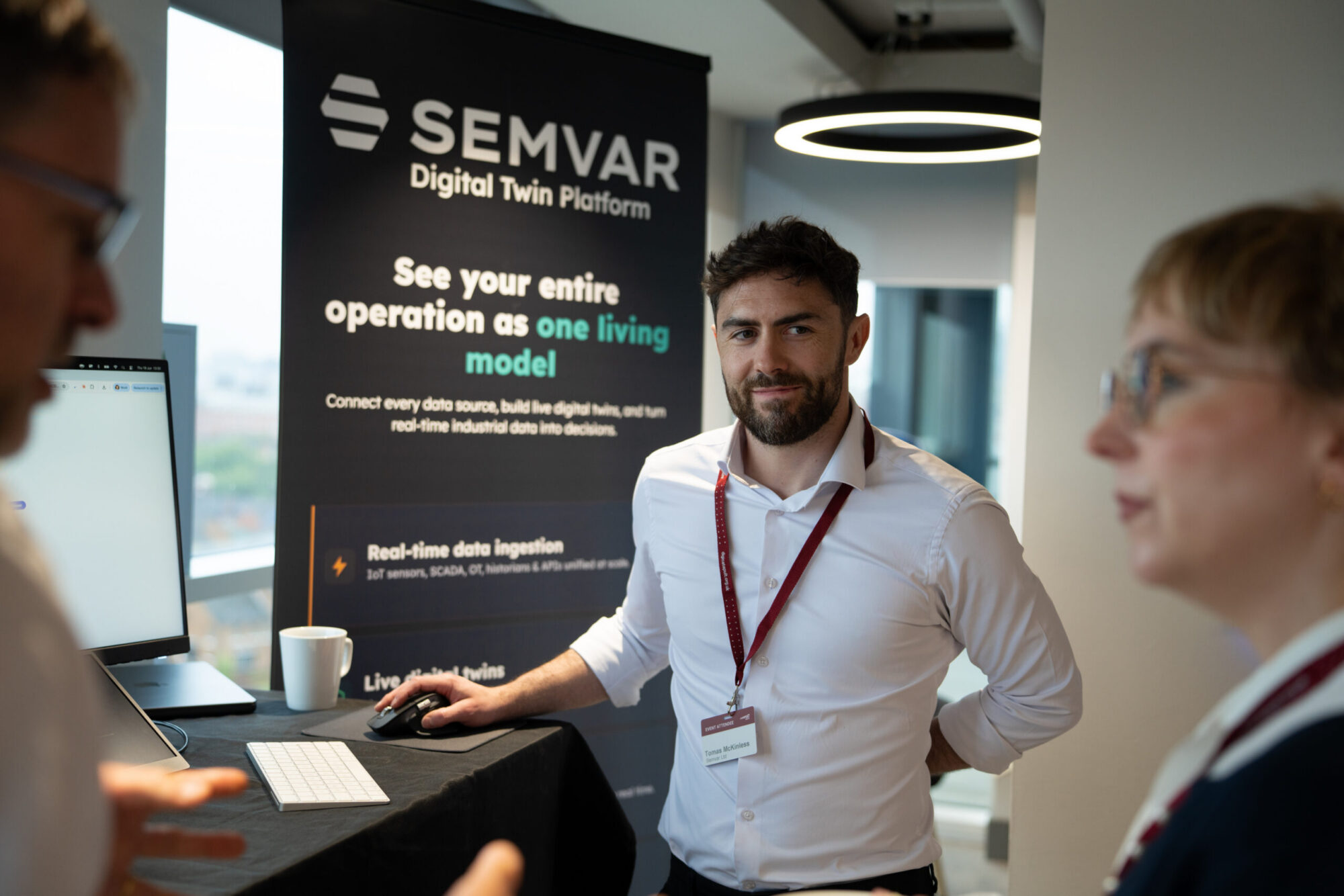
Supported by Digital Catapult and the UK Digital Twin Centre’s Digital Twin Adoption Accelerator, Semvar collaborated with Marine Zero on a digital twin for decarbonised maritime environments.
Semvar Ltd has developed Semvar, a digital twin enablement platform that transforms raw operational data into live, predictive models of physical systems. It has been deployed across smart buildings and mining sites to help operators move from reactive monitoring to data-driven decision-making that supports efficiency, safety, and decarbonisation. A strategic priority for Semvar Ltd was to prove the platform in maritime where the decarbonisation pressure is acute and the data infrastructure is increasingly available. Marine Zero operates the CONNECT platform, which collects live vessel data from ferry fleets across the UK, and has a detailed understanding of the data, operators and practical constraints of the maritime sector and environment.
Together, the Semvar and CONNECT platforms created a working proof of concept digital twin on the Torpoint Ferry fleet operated by Tamar Crossings, using real operational data from a live commercial fleet of three vessels to validate earlier simulated trials, and which can now be demonstrated to any operator in the country.
“Maritime decarbonisation is one of the defining challenges of the next decade. We could see that the data to tackle it was already being collected but it wasn’t being turned into insight. The Digital Twin Adoption Accelerator gave us the structure, the funding, and the right industry partner to change that.” Tomas McKinless, CEO, Semvar
Maritime is one of the most challenging industries to decarbonise. Vessels have long asset lives, switching the type of fuel a vessel uses requires significant capital investment, and operators typically have thin margins and, while increasingly available, are currently often working with limited data infrastructure. Regulation within the sector is tightening, new fuels and propulsion technologies are emerging, and tools are needed to model the impact of changes before capital is committed.
Before joining Digital Catapult and the UK Digital Twin Centre’s Accelerator programme, Semvar Ltd had an established digital twin platform with proven deployments in other sectors. Meanwhile, Marine Zero’s CONNECT platform was collecting rich live data from vessels including GPS, power draw, voltage and current – but that data wasn’t being turned into insight. Semvar Ltd wanted to close that gap and give operators a real-time, predictive window into their fleet’s energy behaviour to optimise operations, reduce emissions, and plan confidently for zero-emission futures.
Digital Catapult and the UK Digital Twin Centre’s Adoption Accelerator provided funding that enabled Semvar Ltd to move from idea to live proof of concept deployed on a real commercial fleet in under a year. Structured check-ins also kept the team accountable to milestones and provided a clear framework to work within.
Engagement with Digital Catapult’s expert team sharpened the Semvar team’s thinking on commercialisation. This included framing the value proposition for operators who are not technologists and structuring a route to market through a platform partner like Marine Zero rather than building a direct sales function from scratch.
Digital twins offered a solution that dashboards and analytics tools alone cannot: a continuously updated, physics-informed model of a physical system that can be queried, simulated, and used to generate predictions.
Semvar Ltd built a digital twin layer directly on top of Marine Zero’s CONNECT platform. It pulls live data including GPS position, electrical power, voltage and current, from vessels. The digital twin transforms that raw data stream into a dynamic, continuously updated model of each vessel’s energy infrastructure, augmented with third-party weather and tidal data so that energy use could be understood in context.
Development was phased. It started by auditing the data architecture and building a sandbox reporting environment seeded with all available historical data. This let the team develop and test without waiting for a live API connection. Then, the energy modelling layer was built – including an offline calculator that operators could customise – followed by an interactive user interface and digital twin API.
The system was first validated through simulated trials with historical data, then deployed live on the Torpoint Ferry fleet operated by Tamar Crossings, where it ran continuously across three vessels for the duration of the programme.
Tidal and weather integration pointed toward vessel routing optimisation as a future capability. Deploying on a ferry fleet, with its regular fixed routes and rich longitudinal data, showed how quickly a digital twin accumulates the training data needed for high-quality machine learning forecasting. The team came out of the programme with a much clearer picture of the roadmap and a stronger conviction that this was a platform business, not a single-use tool.
The project delivered several new capabilities. An offline energy calculator was built which allows operators to model energy use and explore “what-if” scenarios directly from the platform’s interface. A digital twin API was developed and authenticated, enabling integration with third-party data sources including live weather and tidal feeds. An interactive user interface was also delivered that presents fleet energy data in real time, including a live map replay of vessel movements. AI-generated fleet reports were developed that summarise energy performance and flag anomalies.
The most immediate benefit for operators is replacing delayed, invoice-based fuel data with live visibility and proactive fleet management. The most significant milestone was the live deployment: three vessels of the Torpoint Ferry fleet were modelled continuously, 24 hours a day, seven days a week. Over the course of the seven-month pilot, the system collected and analysed more than 100 million energy data points.
The early-warning capability demonstrated during the project has direct commercial value. The digital twin identified an anomaly in a vessel’s energy signature four days before a critical motor bearing failed, showing that the system could detect mechanical degradation before it becomes a visible problem. This avoided a significant unplanned outage, preventing 70 tonnes of CO2 emissions that would have resulted from the vessel being out of service.
More broadly, the digital twin provides an evidence base for decarbonisation decisions. Operators can see exactly where their energy goes, model the impact of operational changes, and make investment decisions with confidence rather than guesswork. Industry research suggests that operational efficiency measures of this kind can reduce fuel consumption by at least 25% on existing vessels, which at 50–60% of operating costs represents a significant financial and environmental opportunity.
Semvar Ltd ended the Digital Catapult programme with a fully defined commercial model and a structured go-to-market plan. Its channel partnership with Marine Zero provides a route to market through an established industry partner with existing operator relationships, dramatically reducing the cost and time of acquiring new customers.
Digital Catapult and the UK Digital Twin Centre’s Digital Twin Adoption Accelerator has significantly accelerated Semvar’s maritime roadmap and changed its investment priorities. It is now committed to productising its platform and investing in sales capacity, rather than continuing to explore whether the technology works. It aims to secure two or three paid pilots by the end of 2026.
The global maritime decarbonisation market is projected to reach approximately $22 billion by 2030, and Semvar Ltd has estimated the UK addressable market at approximately £30 million annual recurring revenue. This is based on roughly 3,000 vessels, including registered commercial vessels and the workboat fleet, at approximately £10,000 per vessel per year. Port monitoring adds a further revenue layer across more than 120 commercial ports around the UK.
This project has delivered a meaningful competitive advantage in a market that is still in the early stages of applying deep tech. The Tamar Crossings use case gives credibility with other ferry operators that would otherwise take years to build, and the Marine Zero partnership is a channel that competitors without a similar relationship would struggle to replicate.
While focusing on production robustness, Semvar Ltd is preparing for commercial launch in 2027 and has an ambition to become the standard digital twin layer for UK ferry and port operators, as well as a route to European and global markets through platform partnerships. Digital twins will sit at the centre as a continuously learning system that becomes more valuable as it accumulates operational data across more vessels, routes, and conditions.
Tamar Crossings is in discussion about extending the deployment, and the programme network has generated early-stage conversations with other operators.
“When our digital twin flagged an anomaly in a vessel’s energy data four days before a motor bearing failed, that was the moment the technology proved itself. We had a real fleet with real operational data, and a real early warning that could have prevented weeks of disruption and 70 tonnes of avoidable CO2. We’re leaving the programme with a validated product, a reference customer, and a clear commercial path. The ambition now is to make this the standard for every operator in UK waters.” Tomas McKinless, CEO, Semvar Ltd