






Digital Supply Chain Programme: Made Smarter Innovation | Digital Supply Chain Hub
Creating a virtual hub, data observatory and network of industrial living labs to optimise information flows across manufacturing supply chains.
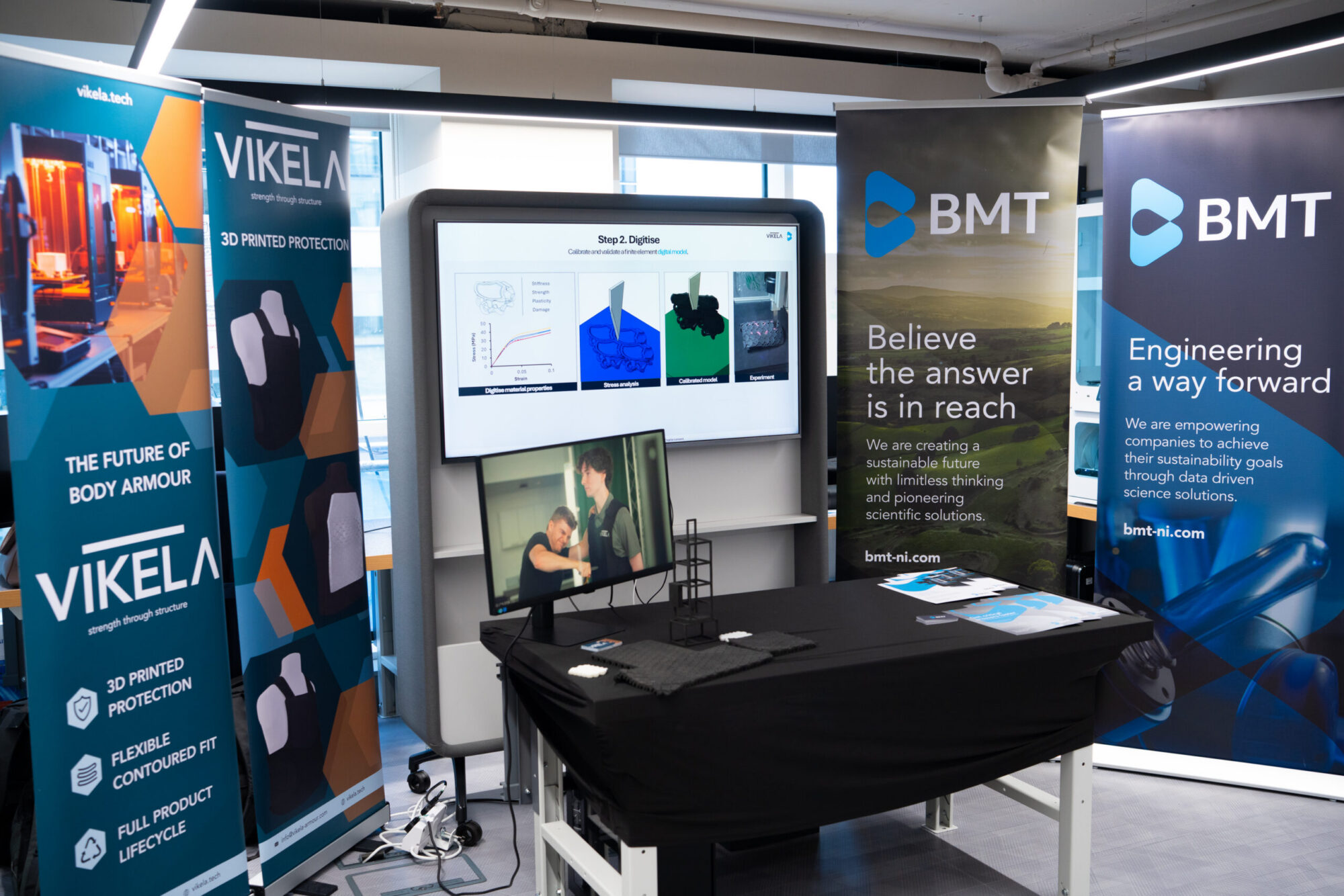
Blow Moulding Technologies (BMT) helps organisations innovate faster and with greater confidence by combining physical testing, simulation and digital engineering. By transforming real-world data into evidence-based engineering insight, BMT enables customers to reduce development risk, accelerate product development and make more informed decisions before committing to prototypes, tooling or production. This is particularly important in sectors where product performance, safety and reliability are critical.
For the Digital Twin Adoption Accelerator delivered by Digital Catapult through the UK Digital Twin Centre, BMT partnered with Vikela, a Northern Ireland company developing innovative lightweight body armour solutions. The companies had both previously been part of the same cohort of Digital Catapult’s smart manufacturing accelerator delivered as part of the Smart Nano NI programme in 2022.
Vikela wanted to speed up product development, explore more design options and gain greater confidence in performance before committing to costly physical prototypes and testing. BMT saw an opportunity to demonstrate how advanced simulation, material characterisation and digital twin technologies could be applied to a highly demanding defence-sector challenge.
Working collaboratively and supported by specialist technical insights from Digital Catapult’s team, BMT and Vikela created a body armour digital twin that predicts knife impact and penetration to demonstrate that material testing, product testing, advanced simulation and emerging AI-driven approaches could be combined within a single armour-development workflow. Working this way enabled faster design iteration, reduced physical testing and improved armour performance. Ultimately, helping to keep people safer.
Developing lightweight, high-performance body armour presents a complex engineering challenge. Manufacturers must balance protection, weight, comfort, flexibility and manufacturability, while demonstrating reliable performance in safety-critical applications. Traditionally, this relies heavily on iterative physical prototyping and destructive testing, which can be costly, time-consuming and limits the number of design options that can realistically be explored.
Across the manufacturing and engineering sectors, there is growing pressure to reduce development times and bring innovative products to market more quickly without compromising quality, performance or safety. Organisations increasingly need digital tools that enable data-driven decision making while maintaining confidence in real-world performance. Digital twin technology offered a route to connect physical testing with predictive simulation, creating a foundation for more efficient product development, reduced technical risk and better-informed engineering decisions.
Vikela needed to prove that its stab-testing process could be represented virtually, that real material data could be incorporated into the digital model, and that the digital twin could reproduce key aspects of armour performance with sufficient accuracy to support engineering decision-making.
BMT developed a digital twin for Vikela’s lightweight body armour and stab-testing process, and led on simulation, material characterisation and analysis. Vikela provided the operational, testing and validation expertise. The solution integrated three key elements:
The project began by creating a digital representation of Vikela’s physical stab-test process, capturing the geometry, loading conditions, material behaviour and key performance metrics. Material specimens and armour samples were then tested to generate the data required to calibrate and validate the digital twin.
While the primary focus was establishing and validating the digital twin concept, the work also laid the foundations for future AI-enabled approaches that could rapidly assess design performance, explore design alternatives and support faster engineering decision-making. This created a workflow in which proposed armour designs can increasingly be evaluated virtually before physical prototypes are manufactured, reducing development risk and enabling a more informed, data-driven approach to product development.
“BMT helps organisations connect physical behaviour with digital insight to make faster, more informed engineering decisions. Through our collaboration with Vikela, we saw an opportunity to apply these principles to a safety-critical defence application, developing a digital twin that could accelerate product development, reduce development risk and lay the foundations for future AI-assisted optimisation.” Dr Ross Blair, Head of Engineering, BMT
The Digital Twin Adoption Accelerator provided the funding, expertise and industry connections needed to transform an early-stage concept into a validated proof of concept. Working with Digital Catapult and the UK Digital Twin Centre helped accelerate progress by combining technical support, access to workshops covering commercialisation, intellectual property, investment readiness and defence-sector market opportunities, and regular touch points to ensure the project remained focused not only on technical feasibility, but also on potential routes to practical application and commercial impact. The consortium moved to a validated proof of concept much faster than would otherwise have been possible.
The digital twin provides a foundation for future AI-assisted design optimisation, allowing new materials, geometries and manufacturing variables to be evaluated more rapidly as additional data becomes available.
Prior to the accelerator, BMT had extensive experience connecting physical and digital worlds within the fast-moving consumer goods (FMCG) sector but had not explored how these same principles could be applied to a safety-critical defence application such as lightweight body armour. Both organisations are now at the forefront of applying digital twin technologies within safety-critical engineering and advanced manufacturing applications.
Beyond the technical outcomes, the accelerator also helped establish new industry relationships, validated a new application area for digital twins and created a foundation for future digital engineering and AI-enabled capabilities within the defence sector.
The programme successfully demonstrated the feasibility of applying digital twin technology to lightweight armour development. Key achievements included:
Vikela can now assess and refine armour designs far earlier in the development process when changes are faster, lower risk and significantly less expensive to implement. It can make better-informed decisions around geometry, materials and performance trade-offs using predictive simulation. It also reduces reliance on iterative trial-and-error development and focuses physical testing on validation and certification activities.
The anticipated long-term impact is substantial. A simulation-led development workflow could reduce the number of physical development iterations by 30-50%, shorten design cycles from months to weeks for many design changes, and significantly reduce the time and cost associated with evaluating new concepts. This is particularly valuable in safety-critical applications where physical testing remains essential but can be targeted towards the most promising designs.
The project also opens the opportunity to create a scalable digital platform that can support future armour programmes, licensing opportunities and AI-enabled product development capabilities.
For Vikela, this provides a pathway towards faster innovation, lower development costs and a stronger competitive position within a global body armour market worth an estimated $2-3 billion, with potential future software and digital service opportunities alongside physical product sales.
“The programme helped us move from an early concept to a validated proof of concept far more quickly than would have been possible independently. The combination of technical support, commercial guidance and access to the wider Digital Catapult ecosystem ensured we focused not only on technical feasibility, but also on long-term commercial value.” Dr Ross Blair, Head of Engineering, BMT
This project has created opportunities for follow-on R&D, collaborative innovation programmes, customer-funded projects and expansion into adjacent markets where connecting physical testing with digital engineering can deliver value.
The next step is to build on the proof of concept and further develop the capability through additional validation, broader design exploration and increased integration into product development workflows.
For Vikela, this means applying the approach to additional armour designs, materials and performance scenarios, with the long-term goal of accelerating product development and reducing reliance on iterative physical testing.
For BMT, the project established a strong foundation for expanding digital twin technologies beyond traditional Fast-Moving Consumer Goods markets and into defence and other safety-critical industries. There are opportunities to further develop simulation-led engineering services, integrate future AI-assisted design capabilities and support a wider range of customers seeking to connect physical testing with digital decision-making.