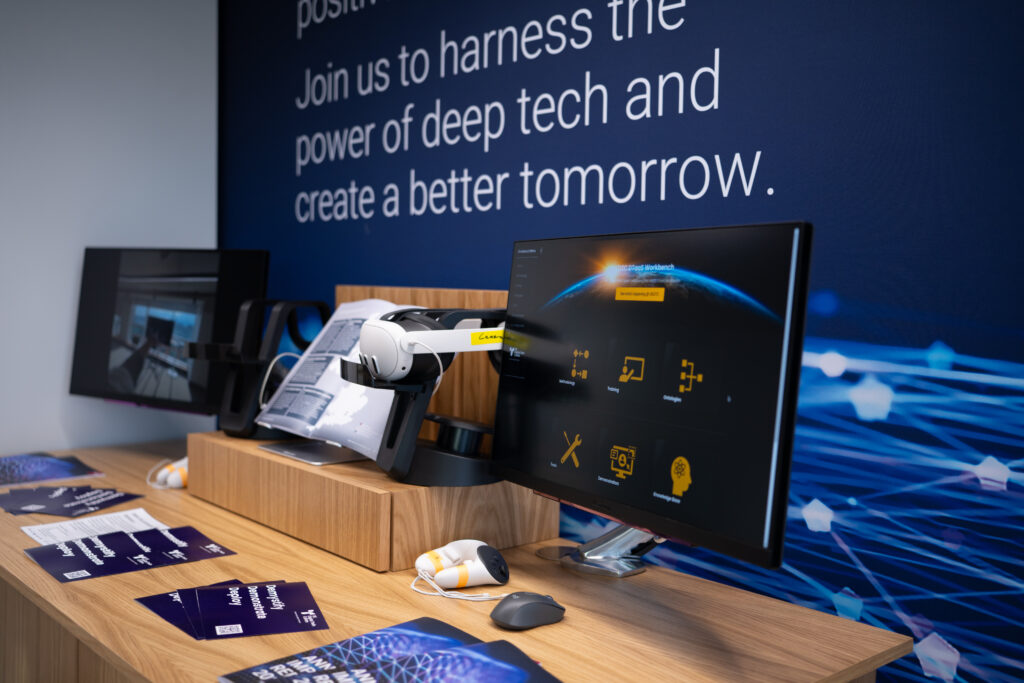







Digital Supply Chain Programme: Made Smarter Innovation | Digital Supply Chain Hub
Creating a virtual hub, data observatory and network of industrial living labs to optimise information flows across manufacturing supply chains.

The UK’s most strategically important industries including advanced manufacturing, energy, defence, transport and logistics are converging on a common requirement: connectivity that is fast, predictable, secure and locally controlled. Standalone Non-Public Networks (SNPN), the industry term for private 5G, have emerged as the enabling infrastructure for this shift. Adoption however has been largely fragmented, with each deployment reinventing its own architecture, security posture and energy model.
The UK Anchored Blueprint for SNPN changes that. Developed as part of the Assured 5G Technical Authority (A5G-TA) Programme delivered by Digital Catapult and funded by Innovate UK, which sets out to support the development and rollout of secure, private 5G networks across critical areas of the UK economy, alongside the UK’s first Telecom AI-native auditing and network assurance framework. The UK Anchored Blueprint for SNPN sets out a common, reusable reference approach that lets the UK move from bespoke, one-off private-network projects toward a repeatable national capability, one that can be deployed, assured, operated and scaled across sectors. Four themes anchor the blueprint namely: the reference architecture, security, energy efficiency and performance requirements.
Rather than prescribing five different networks for five different sectors, the blueprint defines a single disaggregated, cloud-native and increasingly AI-native reference architecture that any sector can build on. It draws on established standards, 3GPP 5G Standalone SNPN specifications, O-RAN’s disaggregated radio access network model, and ETSI’s Multi-access Edge Computing framework, and adds common orchestration, automation and time synchronisation.
Two design choices matter most for business leaders. The first is disaggregation and open interfaces: separating the network into modular, upgradeable components, such as radio units, distributed, central units, and core functions, opens the door to multi-vendor deployments. That means a wider supplier choice, reduced lock-in, and room for UK technology companies and SMEs to compete for parts of the technology stack, rather than being shut out by single-vendor ecosystems.
The second is local autonomy first: every SNPN must keep operating safely and independently even if wide-area connectivity, cloud services or remote orchestration are lost. This is non-negotiable for defence, energy and safety-critical sites, and it shapes how Artificial Intelligence (AI) is used. AI enhances operations, optimisation, anomaly detection and predictive maintenance, but it should not become a dependency for mission-critical functions.
Given that SNPNs sit inside environments where a cyber incident can affect physical safety, production lines or national infrastructure, the blueprint treats security as a lifecycle requirement built into the architecture from day one, not a layer added-on afterward.
The approach rests on five principles:
These map onto established frameworks including National Cyber Security Centre (NCSC) guidance, ISO/IEC 27001, NIST CSF 2.0, IEC 62443 and O-RAN and GSMA security specifications, giving assurance teams a recognised baseline rather than a bespoke standard to defend. Crucially, the framework extends security beyond the radio network into the areas that matter most to industrial operators such as identity and trust management, OT/IT convergence, supply-chain assurance for multi-vendor equipment and measurable security KPIs that provide the evidence to demonstrate assurance.
Sustainability is treated with the same architectural seriousness as security, embedded into the network design and operating model rather than addressed as an afterthought. The blueprint sets out an energy-aware architecture that continuously collects data on radio load, compute utilisation, carbon intensity and renewable energy availability, then feeds it into AI-driven optimisation that can, for example, shift non-urgent workloads to periods of high renewable supply or consolidate compute to cut idle power. To make that ambition auditable rather than aspirational, the blueprint sets indicative targets for every deployment to report against:
The blueprint’s fourth pillar translates industrial ambition into measurable, standards-based network requirements, a layered framework running from business objectives and use cases, through the three core 5G service classes, eMBB for high-capacity data, uRLLC for deterministic control, mMTC for massive IoT, down to concrete KPIs, SLAs and monitoring. This traceability is exactly what evidence-based private 5G deployments depend on.
Because 3GPP defines performance classes and ranges rather than one-size-fits-all numbers, the framework lets each vertical set targets appropriate to its own risk and business case, while still reporting against a common, comparable methodology.
The blueprint’s core message to industry and government is simple: the question is no longer whether every site should have a private 5G network, but whether the UK builds the shared architecture, security assurance, energy standards and performance methodology that let SNPNs be deployed securely, sustainably and at scale wherever they create real value. This blueprint gives the stakeholders a common reference point to align investment, procurement and risk decisions, and a credible route to a genuinely sovereign, resilient industrial connectivity capability.

The A5G-TA Programme builds on Digital Catapult’s deep expertise in advanced connectivity technologies by supporting the UK’s digital and technology sector with past programmes like SONIC Labs and UKTIN. If you would like to learn more about programme, the blueprint and future connectivity testing capabilities, get in touch with our team.


Join Digital Catapult, Satellite Applications Catapult and Semiconductor Catapult for this briefing webinar introducing the Advanced Connectivity Technologies Growth Programme.

Applications are open to UK businesses for the Advanced Connectivity Technologies Growth Programme, supporting UK businesses looking to scale deep…
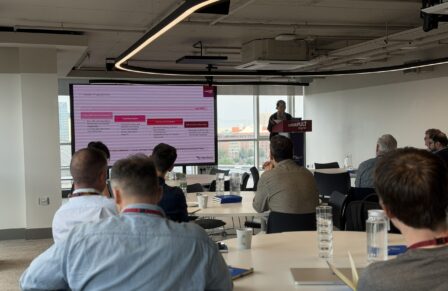
Digital Catapult has concluded its Advanced Connectivity Technology Access Programme with Smart Nano NI, showcasing how SMEs are using private…
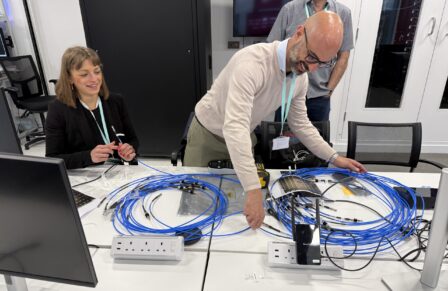

Digital Catapult has launched the Smart Nano Advanced Connectivity Technology Access Programme, bringing together 10 companies to accelerate real-world applications…