






Black Founders Programme
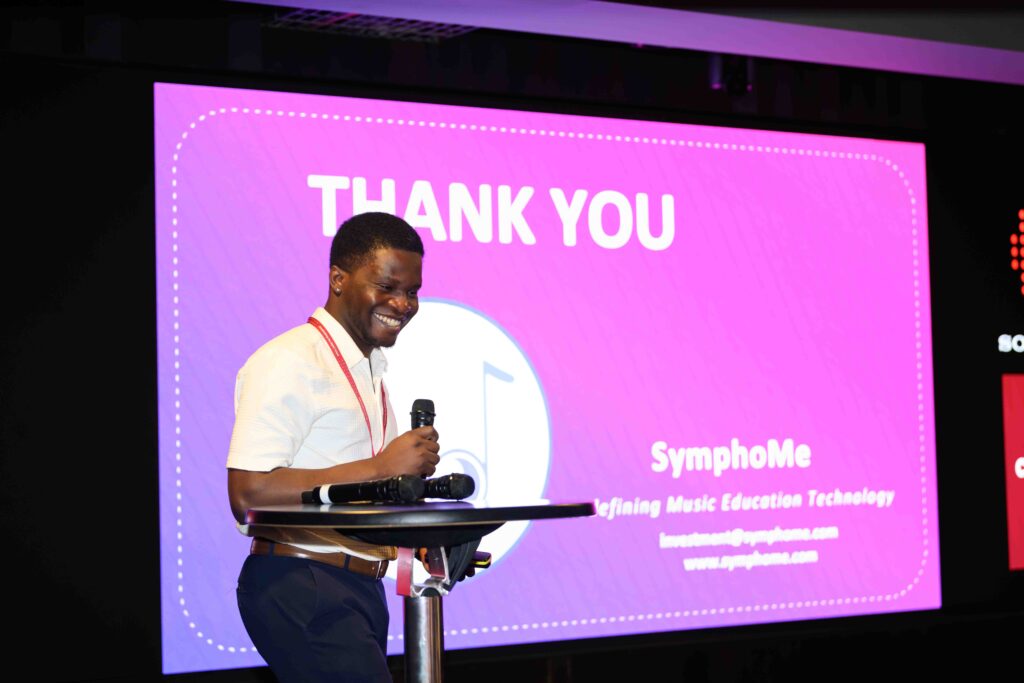
The Black Founders Programme is targeted at early stage and pre-seed, Black-founded companies creating innovative products and services for the...

With the culmination of the UK Telecoms Innovation Network (UKTIN) at the end of March, Digital Catapult has explored its enduring contribution to the country’s telecoms sector.
Our end-of-programme report captures the achievements of the past three years, and tells the story of a sector that has fundamentally shifted from one of fragmentation to cohesiveness. The report illustrates how this has been driven by the work of Digital Catapult and the UKTIN programme partners.
UKTIN reshaped how the UK comprehends, coordinates, and compels its telecoms innovation ecosystem. As the UK moves into the era of advanced connectivity technologies (ACT) and AI‑native networks, this transformation comes at an important moment in time.
Here are some of the key areas of impact achieved by the UK telecoms innovation network:
UKTIN has helped show where telecoms technologies are going with the creation of the UK’s first coordinated, cross‑ecosystem set of Future Capability Roadmaps. Led by Digital Catapult, the University of Bristol, Satellite Applications Catapult, and the Compound Semiconductor Applications Catapult, these roadmaps offer clear guidance to government, industry, and academia on where the UK should focus investment and research.
Digital Catapult built the UK’s first and most comprehensive technical expert consultation structure for the whole UK telecoms industry, with a single vision and ambition to provide in-depth technical expert advice and guidance to develop the UK’s capabilities in advanced connectivity.
Across nine Expert Working Groups, from AI and wireless to photonics, security, Non-Terrestrial Networks (NTN) and standards, more than 180 experts consolidated national strengths, capability gaps, and long‑term research priorities. The groups produced comprehensive reports that provided analysis and recommendations to help shape thinking towards the future of connectivity infrastructure development in the UK.
Through UKTIN, Digital Catapult has built on vital ecosystem engagement, supporting commercialisation and scale-up across the sector to equip the UK to be future ready. Combined with market insights and academic research, the sector now has the clarity on the way forward, which it has lacked for decades.
As well as providing clarity on the future of the telecoms sector, UKTIN has also heightened the understanding of what is happening today. Before UKTIN, the UK telecoms innovation landscape was characterised by duplicated activity, inconsistent visibility, and a lack of shared national direction. UKTIN addressed this head‑on, creating the UK’s first trusted national entry point for innovators, government, academia, operators, and investors.
Its Supplier Specialist Guidance Service (SSGS), set up by Cambridge Wireless, supported more than 3,100 individuals and helped organisations navigate a system that was previously difficult to access. It also provided direct connections to testbeds, funding opportunities, and specialist expertise from Digital Catapult, showcasing the value of convening capabilities.
The result was a step‑change in transparency and coherence. For the first time, the UK has a telecommunications ecosystem that understands itself.
The UK’s vibrant start-up community has never been short on ideas, but it has historically struggled to successfully bring them to market.
UKTIN tackled this issue with the Transforming Telecoms Programme, and its Innovation Platform, offering investment readiness workouts, commercial support, and routes to partnership opportunities to bridge the gap between innovation and market adoption. The programme was jointly led by the University of Bristol and the SETsquared Partnership with valuable support from Digital Catapult, Satellite Applications Catapult and Compound Semiconductor Applications Catapult.
Over 300 users registered onto the programme, with many reporting tangible results including new jobs and refined partnership strategies. There is now a pipeline of investable UK ventures stretching beyond UKTIN’s lifetime, enabling deep tech startups to scale.
Telecommunications standards define how networks operate and who shapes the market. Prior to UKTIN, the UK’s influence in global standards bodies such as 3GPP, ITU‑T and IETF was limited.
UKTIN reversed this by establishing a Standards Expert Working Group and appointed a dedicated Standards Champion. This helped to demystify processes, coordinate national positions, and support companies of all sizes to participate in critical standards-setting debates.
Through attendance at standards meetings, publication of expert articles, and dedicated start-up support, UKTIN leaves the UK with a stronger, more coherent presence in global standards development, as new specifications for AI-native networks and ACTs are being shaped.
The Talent Advisory Group (TAG), led by coalition partner WM5G, tackled one of the sector’s most pressing issues: a skills shortage driven by an ageing workforce and a lack of new entrants.
In a bid to attract younger talent to the sector, one of the key strategies of the TAG was to reframe “telecommunications” as “connectivity”. This more closely links the sector to the technologies that the next generation of engineers rely on.
The TAG reached out to over 2.1 million young people during lifetime of UKTIN, and established several new employer-education partnerships, creating the beginnings of a modern, diverse, future‑ready talent pipeline for next‑generation networks.
UKTIN established five sector‑specific Adoption Working Groups in health, transport, manufacturing, agriculture, and regional innovation. The consortium produced over 40 case studies and toolkits that are already informing real‑world deployments of ACTs.
This work provided policymakers with actionable insight, supported early adopters, and built cross‑sector collaboration models that shape national strategy. In short, advanced connectivity is now moving out of the testbed and into the real economy, accelerating the practical deployment and development of open and future networks in the UK.
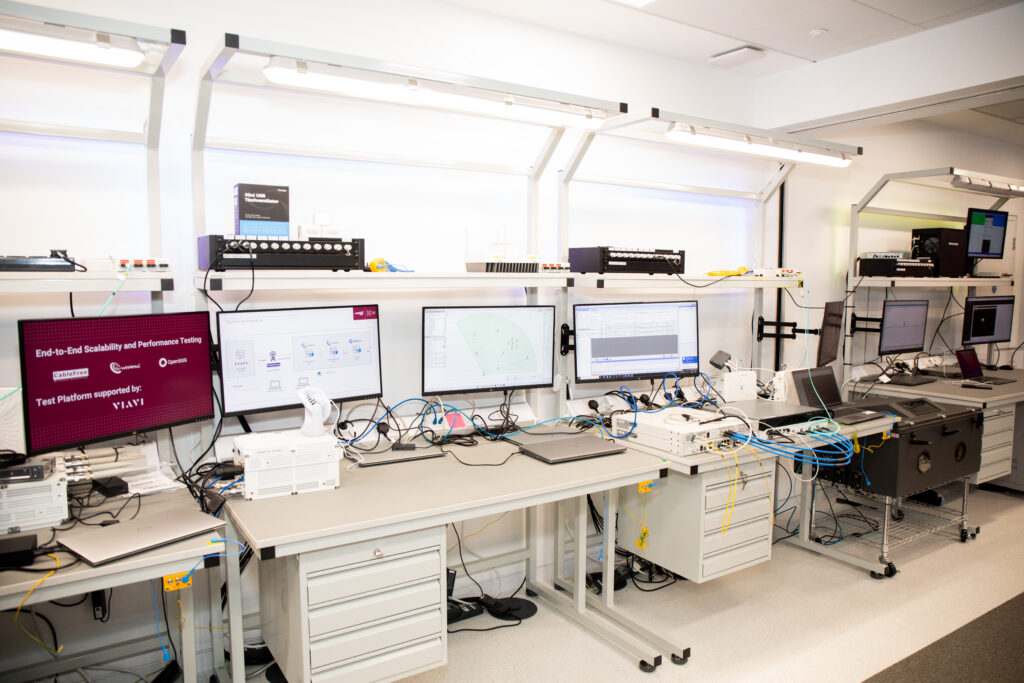
UKTIN also convened a series of workshops for the University of Bristol’s JOINER and Digital Catapult’s SONIC Labs programmes, bringing together users and suppliers for demonstrations, case studies, and presentations on rapid, cost-effective testing.
What comes next?
During its lifetime, UKTIN supported more than 6,500 individuals and 2,800 organisations, created national tools and infrastructures, and delivered measurable, system‑wide improvements across R&D, standards, adoption, skills, and commercialisation.
It changed the culture of UK telecommunications replacing siloed efforts with open, evidence‑driven collaboration. Crucially, it gave policymakers faster, clearer access to expert insight, enabling better decisions in a fast‑moving technological environment.
Our report is unambiguous on this point: the UK now needs a long‑term coordination mechanism to build on UKTIN’s foundations.
UKTIN established a blueprint for a connected, aligned, future‑ready national telecommunications ecosystem capable of shaping the next generation of advanced connectivity. As AI, cloud‑native networks, photonics, semiconductors, and new architectures redefine the sector, the UK now has the strategic tools, relationships, and confidence to lead. With the right long‑term coordination, the UK can cement itself as a global leader in next‑generation network innovation.
To find out more about the legacy of UKTIN and what Digital Catapult plan to do next, download the report and visit the Digital Catapult website.

Learn how Viasat investigated quantum computing to optimise its satellite telecoms network.

Learn how SIMULEX investigated quantum computing to optimise energy networks, including hydrogen storage.

Join us for this interactive online event designed to demystify privacy‑enhancing technologies and showcase what they enable in practice.

Read the story of our role in the growth of the UK’s AI ecosystem from its foundations to today.

Build practical photonics capability through hands-on training in PIC design, simulation, and prototyping, with access to Smart Nano NI infrastructure…

The UK at the AI frontier: challenges and opportunities report, produced by Digital Catapult in partnership with Innovate UK, sets…

A 6 month structured programme that aims to support organisations to accelerate the UK’s quantum readiness by cultivating practical capabilities…

Digital Catapult and Ofcom’s four-year open network testing programme concludes with the UK’s most comprehensive independent evidence base on Open…
Building a connected, confident, and globally competitive UK telecommunications ecosystem
Learn how Viasat investigated quantum computing to optimise its satellite telecoms network.
Learn how SIMULEX investigated quantum computing to optimise energy networks, including hydrogen storage.
Join us for this interactive online event designed to demystify privacy‑enhancing technologies and showcase what they enable in practice.
Read the story of our role in the growth of the UK’s AI ecosystem from its foundations to today.
Build practical photonics capability through hands-on training in PIC design, simulation, and prototyping, with access to Smart Nano NI infrastructure…
The UK at the AI frontier: challenges and opportunities report, produced by Digital Catapult in partnership with Innovate UK, sets…
A 6 month structured programme that aims to support organisations to accelerate the UK’s quantum readiness by cultivating practical capabilities…
Digital Catapult and Ofcom’s four-year open network testing programme concludes with the UK’s most comprehensive independent evidence base on Open…
Building a connected, confident, and globally competitive UK telecommunications ecosystem