






Digital Supply Chain Programme: Made Smarter Innovation | Digital Supply Chain Hub
Creating a virtual hub, data observatory and network of industrial living labs to optimise information flows across manufacturing supply chains.

Digital Catapult’s Quantum Technology Access Programme is raising awareness, educating end users, and fostering industry partnerships to drive the future practical adoption and commercialisation of quantum computing. During this unique programme, quantum experts from Digital Catapult and ORCA Computing supported a range of industrial participants to explore novel quantum computing use cases.
Viasat joined the programme’s second cohort to explore the application of quantum computing to optimise frequency planning in satellite communications.
Viasat is a satellite telecommunications provider, operating geostationary satellite constellations which broadcast in the L and Ka Bands – frequencies which provide extremely reliable global communications. A major challenge for Viasat is deciding how to allocate these frequencies across its satellites so that customers always get strong, uninterrupted service. This task called the Frequency Allocation Problem is a complex puzzle with many possible combinations to consider. Because of this complexity, Viasat’s team explored it as a combinatorial optimisation problem, looking for smarter and more efficient ways to assign frequencies.
Although solving this problem efficiently for large networks is very important for telecoms organisations, it remains a difficult challenge because the cost of the computation rises exponentially with the number of bands and frequencies. In addition, there are other constraints to consider, such as interference across bands, making it difficult to find optimal allocations. Current methods, while effective, often struggle with scalability, leading to suboptimal spectrum utilisation and potential service disruptions. Quantum computing offers a promising alternative solution.
After education and training on quantum computing, the Viasat team worked with quantum computing experts at Digital Catapult and ORCA Computing to formulate the Frequency Allocation problem using the ORCA Software Development Kit (SDK). The team started by implementing an oversimplified toy version/prototype of the problem before adding more constraints to generate a more realistic representation of the problem. Then, on demo day, the problem was run on the ORCA PT-2 quantum boson sampler.
The Frequency Allocation problem ran successfully on the ORCA PT-2 device. The optimal allocation was obtained in a few minutes, and the result was checked by confirming all constraints were satisfied.
One of the interesting results of this work was investigating problem spaces where not all constraints could be satisfied e.g. some interference occurred. Based on initial investigations, the Viasat team discovered that the algorithm found optimal solutions to minimise the impacts of the unsatisfied constraints. This category of problem has very high complexity and such problems offers the potential for future quantum advantage. The Viasat team felt this space needed more research to better understand the formulation so it could be implemented in its current operations.
Some of the contacts we’ve made through the Catapults have opened doors to some potential new projects.
Dimitrios Sagkovits Senior Frequency & Transmission Planner at Visat
The Quantum Technology Access Programme has provided Viasat with an encouraging starting point to continue investigating the proposed formulation. The team believe that this problem shows the direct impacts from intersection of satellite technologies with quantum computing.
Looking forward, Viasat wants to advance its current formulation to fully represent the current satellite landscape and estimate the size of the hardware needed to give it a quantum leap to quantum advantage.

Applications are open to UK businesses for the Advanced Connectivity Technologies Growth Programme, supporting UK businesses looking to scale deep…
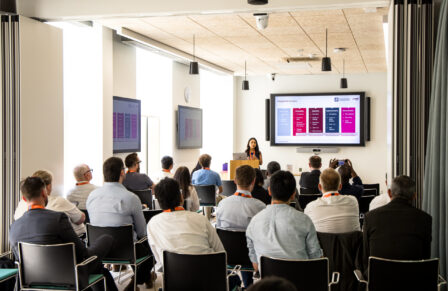
Sector leaders join quantum innovation programme to drive UK industrial transformation

Learn how Viasat investigated quantum computing to optimise its satellite telecoms network.
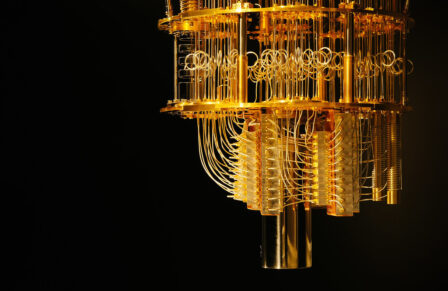
Learn how SIMULEX investigated quantum computing to optimise energy networks, including hydrogen storage.
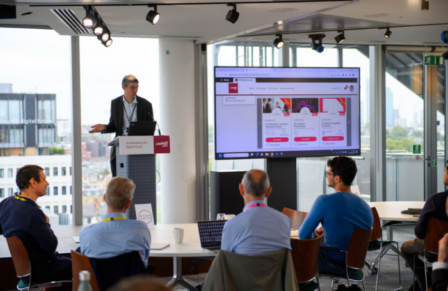
Separating opportunity from hype to understand industry challenges that may be best solved by quantum computing.

Learn how Arup investigated better bridge design using a quantum computer.

Learn how UK Atomic Energy Authority used quantum computing to help design nuclear fusion reactors.

Learn how Frazer-Nash used quantum computing to minimise the cost of energy production.