





Black Founders Programme
The Black Founders Programme is targeted at early stage and pre-seed, Black-founded companies creating innovative products and services for the...

Climate Friendly Travel (CFT) is a not-for-profit programme run by SUNx Malta in partnership with the Ministry of Tourism of Malta and the Malta Tourism Authority. The organisation seeks to transition global tourism towards low-carbon, nature-friendly travel which is aligned with UN Sustainable Development Goals.
CFT operates a global registry of over 800 tourism businesses committed to achieving zero greenhouse gas emissions by 2050. The programme delivers education through a graduate diploma, organises youth summits on climate-resilient tourism, and provides sustainability support to travel companies worldwide – from small island operators to major hospitality providers. With ambitious targets to motivate hundreds of climate-friendly travel communities and thousands of companies by 2030, CFT needs technology that can match the scale of its mission.
CFT had developed a rudimentary proof-of-concept tool to generate climate action plans for tourism businesses. However, the organisation lacked internal AI expertise to transform this early prototype into a scalable, production-ready solution. Without technical capabilities to refine the framework, CFT faced the prospect of manually creating detailed climate action plans – an approach that simply cannot work when hundreds of businesses are on its books.
Tourism is a significant contributor to global emissions, and small businesses often lack resources to develop comprehensive climate strategies. CFT’s vision was ambitious: input a company URL and supporting documents, generate a customised climate action plan within seconds, then enable businesses to refine it themselves. This would unlock the potential for regional funders such as the EU to support climate planning at scale across hundreds of tourism operators, all at the same time.
Delaying AI development would have meant losing ground to larger, more agile organisations already building similar tools.
When CFT applied for funding through the Innovate UK Business Growth scheme, it evaluated over 100 potential delivery partners. Programme Manager Olly Wheatcroft recalled the selection process: “Digital Catapult stood out from a list of 100. We picked two who had the technology and support capability we were looking for, and out of those two, you (Digital Catapult) stood out above the other choice.”
Digital Catapult’s expertise in AI implementation and track record supporting SMEs to develop responsible AI solutions won through. The Innovation Services offering provided exactly what CFT needed: AI use case development and assessment to help define, develop and rigorously assess AI applications before significant investment.
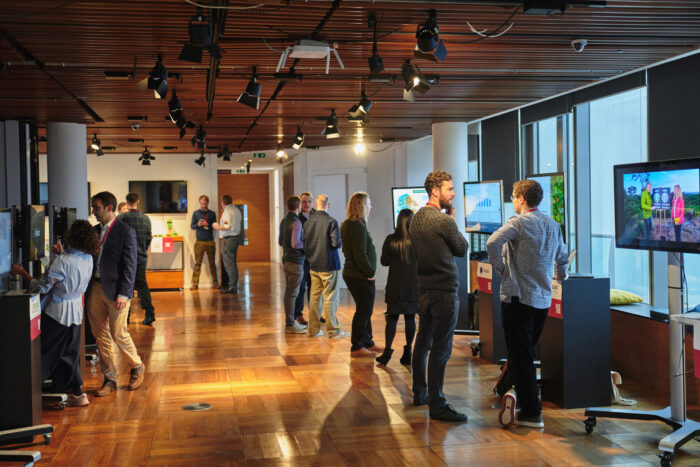
Through the Innovate UK Business Growth RTO Grant, CFT engaged Digital Catapult’s AI use case development and assessment service. The project paired CFT with a Data Scientist and Machine Learning Engineer from Digital Catapult, who brought deep technical expertise in AI architecture and implementation.
The engagement focused on creating a robust technical framework that would enable CFT to move beyond its initial prototype. Digital Catapult’s data scientist conducted comprehensive research into cloud-based solutions including Azure and AWS, explored options that CFT’s existing technology partner hadn’t considered, and ultimately designed an agentic retrieval-augmented generation (RAG) architecture specifically tailored to CFT’s needs.
This architectural approach segments data intelligently and deploys multiple AI agents that perform specific roles, all while working collaboratively as a team. Each agent references relevant information within its domain, creating a sophisticated system where AI components work together to generate accurate, contextualised climate action plans. The framework included critical elements around guardrails and responsible AI implementation to ensure outputs met CFT’s high standards for accuracy and climate impact.
“The biggest thing for us was access to Digital Catapult’s data scientist. They allowed us to explore options which our technology partner wouldn’t have.” Olly Wheatcroft Programme Manager, SUNx Malta
In addition to the technical support provides, Digital Catapult’s business analysis support helped the company compare implementation options with a predefined assessment criteria and translated the technical into business implication and recommendations the company could easily action.
The Digital Catapult engagement delivered tangible acceleration and strategic value for Climate Friendly Travel including:
“This project has taken something which was a rudimentary proof of concept and moved it into a testing and development stage, which was crucial.” Olly Wheatcroft Programme Manager, SUNx Malta
Digital Catapult’s AI and machine learning expert explored multiple approaches, including RAG architectures and Agentic AI to provide insights and offer alternatives that best suited the needs of CFT. Reflecting on this, Olly Wheatcroft emphasised both the technical substance and strategic impact: “The agentic RAG architecture, that use agents to perform specific roles…will be what makes us a very successful tool. We knew about this approach, but for me, that was the real substance of what we are now working to put into action.”
During the ten-week project, Digital Catapult’s support was continuous throughout, adapting to the pace of CFT, and enabling it to unlock forward momentum. “The biggest achievement is that you’ve (Digital Catapult) allowed us to essentially get the ball rolling on something where, if we don’t move fast on it, we’re going to be overtaken by much bigger, more agile organisations who are probably working on this sort of stuff already.”
For organisations requiring AI use case development and assessment to help overcome challenges, Wheatcroft’s advice centres on the value of specialist technical expertise. “Digital Catapult’s data scientist did a lot of research around cloud-based solutions which were dismissed initially but are now actually coming back into play,” he adds. “There were certain things around guardrails and the whole agentic framework which they mapped out that have given us the framework we’ve now put into development.”
The CFT case demonstrates how Digital Catapult’s targeted technical support can accelerate AI readiness for mission-driven organisations, by de-risking innovation, providing access to expertise, and convening capabilities for purposeful collaboration. The project has enabled CFT to scale its impact while maintaining the exacting standards required in producing climate action plans.