





Black Founders Programme
The Black Founders Programme is targeted at early stage and pre-seed, Black-founded companies creating innovative products and services for the...
Digital twins bridge the physical and digital worlds, enabling real-time insights, predictive analytics, and smarter decision-making. But before exploring digital twins in more detail, let’s ask a basic question: what does the term “digital twin” mean? This blog goes to move beyond the buzzword, exploring the capabilities of digital twins, highlighting real-world applications and demystifying this truly transformational technology.
Digital twins are delivering rapid transformation across industries including defence, maritime and aerospace, energy and healthcare. Despite this, many organisations struggle to grasp what digital twins are and, crucially, how to leverage the benefits digital twins offer: from real-time insights and visibility to predictive analytics and enhanced operational control.
Whether you’re new to digital twins or looking to refine an existing strategy, Digital Catapult is the starting point for understanding what makes digital twins different, valuable, and worth investing in. Digital twins have quickly become one of the most talked-about and potentially impactful industrial technologies. Far from being another tech buzzword they, digital twins offer a powerful way to bridge the physical and digital worlds – but only when properly understood and implemented.
The concept of a digital twin is not new. It was first introduced by NASA in the USA during the 1960s, when NASA engineers recreated spacecraft systems on Earth to mirror and predict their performance in space.
The idea itself sounds simple: a digital twin is a virtual representation of a physical asset, process or system that evolves based on real-world data. Beyond that simple description, however, lies the real sophistication and transformative potential of the technology.
At its core, this is a digital replica of a physical entity that allows real-time, bi-directional data exchange between the physical and virtual worlds going far beyond static 3D models or simple simulations. A true digital twin is therefore more than just a digital copy. It’s an interactive system powered by six capability areas: intelligence, integration, user experience and immersive technologies, data services, security and trustworthiness, and cyber-physical asset management. These capabilities determine whether a system simply visualises data, or actively supports prediction, optimisation, and operational decision-making.
The level of integration between the physical entity and the digital entity can be classified into three distinct categories:
Many solutions labelled as ‘digital twins’ are in fact digital models or shadows. While these still offer value, they lack the feedback loop required for real-time control, optimisation, and automation. This distinction is important: organisations expecting “digital twin benefits” from digital models alone often find their projects fail to deliver meaningful impact.
Digital twins can exist at different levels, or scales, of aggregation:
This scalability means digital twins can be applied to everything from a single machine component to an entire facility, infrastructure network, or supply chain. In practical terms, scaling digital twins in this way can lead to greater efficiency, better diagnostics and less costly downtime. As scale increases so does the potential value, but also the need for careful architecture, governance, and integration, something that the UK Digital Twin Centre can help with.
The technology infrastructure supporting digital twins typically includes:
Through these technologies, digital twins transform raw data into increasingly valuable insights, aligned with the Data-Information-Knowledge-Wisdom hierarchy:
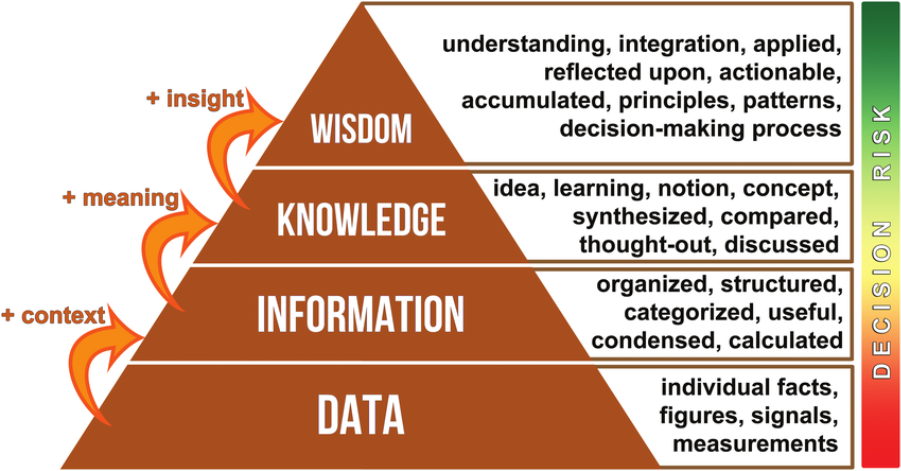
Beginning with simple data collection, digital twins progress to providing contextualised information, actionable knowledge and, ultimately, predictive insights that enable autonomous operation. Ultimately, Digital twins move organisations beyond asking “what happened?” towards “what will happen next?” and, critically, “what should we do about it?”
Digital twins are already transforming operations across multiple industries. For example, in manufacturing, companies like Siemens use digital twins to monitor equipment health, optimise production processes, and predict maintenance needs, achieving up to 30% reduction in maintenance costs and 20% improvement in asset utilisation. In healthcare, digital replicas of organs help surgeons plan complex procedures, while hospital operation twins optimise patient flow and resource allocation, potentially reducing waiting times by up to 15%.
In construction, digital twins of buildings are being used to help predict energy usage, optimise maintenance schedules, and improve occupant comfort, with some implementations achieving energy savings of up to 25%. In each of these cases, the value does not come from the digital model itself, but from the ability to connect data, insight, and action in near real time.
At the UK Digital Twin Centre, we recommend a three-step approach:
Beginning with clear business objectives, rather than technology, is crucial. Initial specific questions for any organisation interested in digital twins include:
As digital twin technology continues to mature, there is increasing integration with established and maturing technologies such as distributed ledger technologies (e.g. blockchain) to support trust and auditability, and federated learning approaches to enable collaborative analytics while preserving data privacy. What’s more, the global digital twin market is growing rapidly, with projections suggesting it could reach $73.5 billion by 2027, representing a compound annual growth rate of some 60%.
Not sure where your organisation sits on the digital twin journey? The UK Digital Twin Centre helps organisations understand their current digital maturity: whether they are working with a digital model, a digital shadow, or a true digital twin, and identify the most practical next step forward. Through expert guidance, hands-on support, and collaborative innovation programmes, we help demystify the path from concept to implementation. We help organisations move beyond the buzzword and focus on real-world value.
Keep a lookout for upcoming events such as workshops and lightning talks, where we’ll break down the technologies and methodologies that make digital twins work.
Join the UK Digital Twin Centre to learn how this transformative technology can drive efficiency, cost savings and business innovation.
Contact us to explore collaboration, schedule a consultation, or discuss your project needs: [email protected]