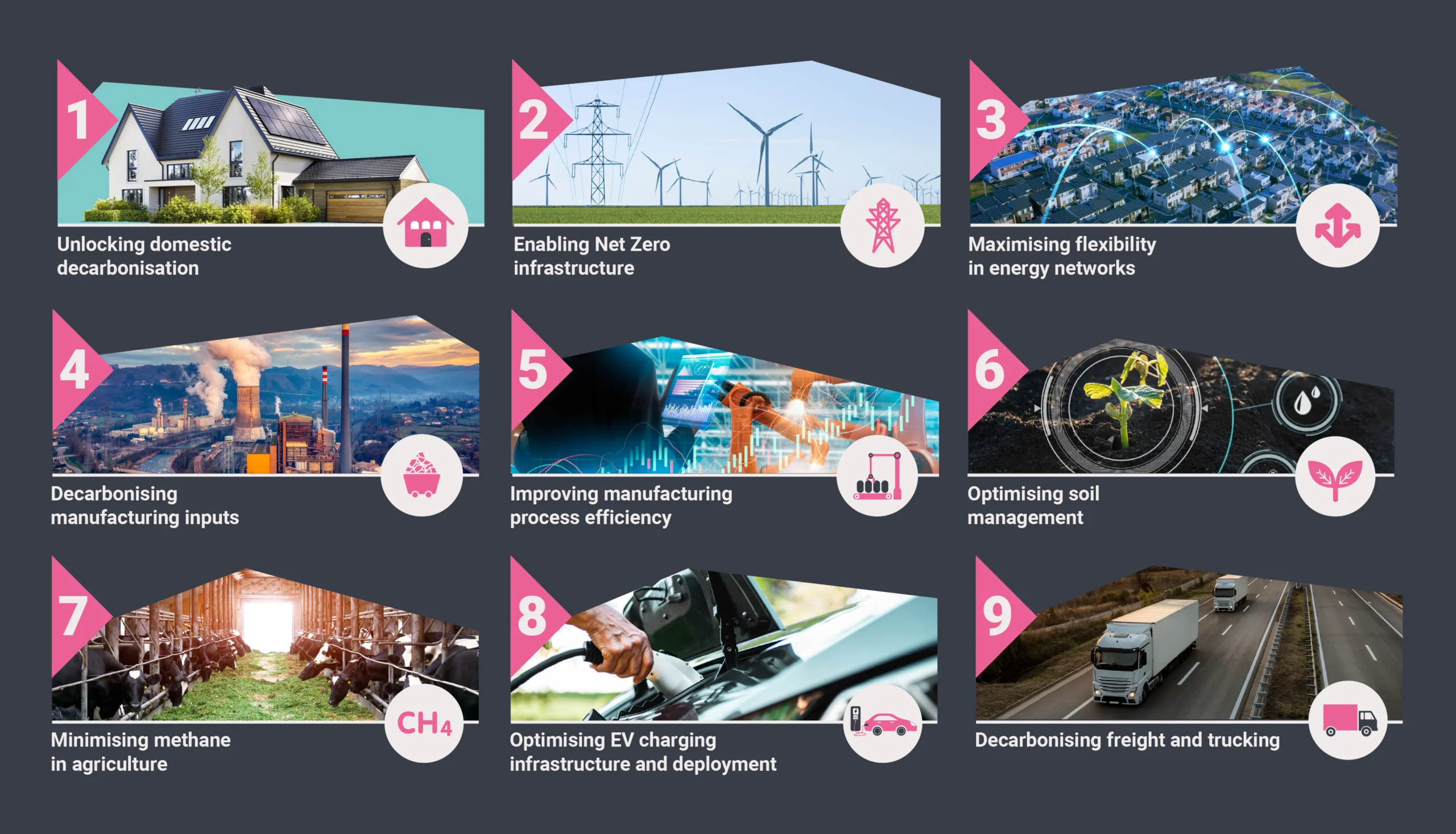
Agriculture is among the hardest sectors to decarbonise because its emissions come largely from biological processes rather than burning fuel. Soil is both a major source of emissions and a potential route to carbon sequestration, while methane from livestock is a significant contributor to the UK’s footprint. AI can help by optimising soil and land management from an emissions perspective and informing lower-carbon livestock management and dietary shifts — though progress here depends as much on incentives and behaviour as on technology
Decarbonising homes and buildings is essential to meeting the UK’s Net Zero targets — residential heating alone accounts for more than 13% of greenhouse gas emissions each year. The challenge is not only technical: it means changing both heating systems and consumer behaviour in every home in the country, then financing and delivering that at pace. AI can accelerate uptake by improving how low-carbon homes are planned, designed and operated.
A clean power system needs far larger electricity networks and smarter ways to manage them, as electrified heat and transport meet a surge in renewable generation. Much of that new generation is currently held up by delays and uncertainty in grid connections, and a high-renewables system also requires demand to flex – consuming and storing energy when the wind is blowing and the sun is shining. AI applications are proving value in forecasting and the real-time optimisation that flexible operation depends on, and can further accelerate network planning.
Many manufacturing processes (involving steel, cement, and chemicals) rely on carbon-intensive fuels and raw materials, making them some of the most difficult and costly emissions to eliminate. Fully decarbonising them requires a wholesale redesign of processes and products around low-carbon inputs, while improving efficiency offers nearer-term reductions for the hardest-to-abate processes. AI can support both: optimising existing processes and helping identify lower-carbon material and design choices.
Transport decarbonisation hinges on electrification, but installing EV charging and operating it intelligently (without disruptive, expensive impacts on the networks) is a real challenge, and better battery technology remains a key lever for increasing adoption. Freight and fleets are harder still, given the heavy, long-range and highly variable demands of HGVs, buses, delivery fleets and ports, set against high upfront costs in an industry of small businesses. AI can help by operating EV charging intelligently and optimising fleet and logistics operations.